

If you have ever looked at investment options and felt confused by words like equity funds, debt funds, SIP, NAV, and asset allocation, you are definitely not alone. Mutual funds can seem complicated when you first hear about them, but the basic idea is actually quite simple.
A mutual fund collects money from many investors and invests that money in different financial assets. Depending on the type of fund, this could include shares, bonds, government securities, or other investments. A professional fund manager takes care of the portfolio according to the fund’s objective.
For someone who is new to investing, mutual funds can be an easier way to get exposure to a group of investments instead of choosing every individual security on their own. However, mutual funds are not risk-free, and different funds can behave very differently.
Before investing, it is worth understanding what you are buying, how the fund works, what risks are involved, and whether it fits your financial situation.
What Is a Mutual Fund?

Think of a mutual fund as a shared investment pool.
Suppose thousands of people invest money in the same mutual fund. The fund combines that money and uses it to purchase investments according to its stated objective. Each investor owns units of the fund based on the amount they have invested.
The value of those units changes depending on the value of the investments held by the fund.
For example, an equity mutual fund may invest in shares of several companies. If the overall value of those shares rises, the value of the fund may rise as well. If the market falls, the fund’s value can also fall.
This is one reason why it is important to remember that mutual funds are investments, not guaranteed-return savings products.
Main Types of Mutual Funds

There are many kinds of mutual funds, and each one has a different purpose. Understanding the broad categories can make it easier to narrow down your options.
Equity Mutual Funds
Equity funds primarily invest in shares of companies.
Because stock prices can move up and down considerably, equity funds generally involve market risk. They may be considered by investors who have a longer investment horizon and are comfortable with fluctuations.
Within equity funds, there can be different approaches. Some funds focus on large companies, while others invest in mid-sized or smaller companies. Some follow a particular sector or theme.
The important thing is to understand where the fund invests before putting money into it.
Debt Mutual Funds
Debt funds invest primarily in fixed-income securities such as bonds and other debt instruments.
They are generally different from equity funds in terms of the type of assets they hold, but that does not mean they are completely risk-free.
Debt funds can be affected by factors such as interest-rate movements and the credit quality of the securities in their portfolio.
Someone looking for a relatively different risk profile from equity investing may explore debt funds, depending on their financial goals and time horizon.
Hybrid Mutual Funds
Hybrid funds combine different asset classes, commonly equity and debt.
The idea is to create a portfolio that does not depend entirely on one type of investment.
Different hybrid funds can have very different equity and debt allocations, so it is important to look at the actual scheme rather than assuming every hybrid fund carries the same level of risk.
Index Funds
Index funds aim to track a particular market index.
Instead of trying to select stocks that will outperform the market, an index fund generally attempts to follow the composition and performance of its chosen index, subject to tracking differences and expenses.
Because the strategy is designed around tracking an index rather than actively selecting investments, these funds may have a different cost structure from actively managed funds.
Tax-Saving Mutual Funds
Some mutual fund schemes are designed to provide tax benefits under applicable tax laws. In India, Equity Linked Savings Schemes, commonly known as ELSS, fall into this category.
Tax rules can change, and the benefit depends on the applicable law and the investor’s circumstances. Anyone considering a tax-saving fund should check the current rules before investing.
Benefits of Investing in Mutual Funds
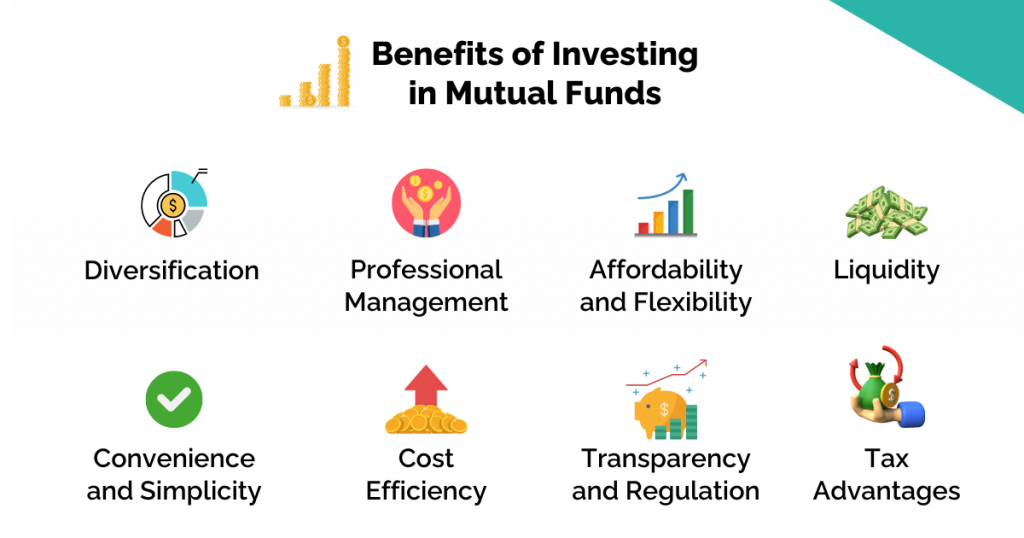
Mutual funds have several features that make them interesting to investors.
Diversification
One major benefit is diversification.
Instead of putting all your money into one company’s shares, a mutual fund may spread the money across many securities.
This can reduce the impact that one individual investment has on the overall portfolio, although diversification cannot eliminate market risk.
Professional Management
Another feature is professional management.
A fund manager and investment team research securities, construct the portfolio and make investment decisions according to the fund’s strategy.
This can be useful for people who do not have the time or knowledge to research individual investments themselves.
Small Investment Amounts
Mutual funds can often be started with relatively small amounts, depending on the scheme and platform.
This makes them accessible to people who want to begin investing without waiting until they have a large amount of money available.
What Are the Risks of Mutual Funds?
Mutual funds are not guaranteed investments.
The level of risk depends on the type of fund and the assets it holds.
Market Risk
Equity funds can rise and fall with the stock market. Even a well-managed fund can experience periods of decline.
Interest Rate Risk
Debt-oriented funds can be affected by changes in interest rates. The impact depends on the type and maturity of the securities held.
Credit Risk
Some debt investments carry the possibility that the issuer may have difficulty meeting its obligations.
Liquidity Risk
Certain securities may be harder to sell quickly at a favourable price, depending on market conditions.
How to Invest in Mutual Funds

The actual process can be fairly straightforward, although the exact steps depend on the platform or provider you use.
Step 1: Complete the Required Verification
Investors generally need to complete the applicable KYC and verification requirements before investing.
Make sure the information you provide is accurate and use an authorised platform or intermediary.
Step 2: Decide How Much You Can Invest
Do not decide the amount simply because someone online says that you should invest a particular percentage of your income.
Look at your own finances first.
Keep necessary expenses and emergency savings in mind before deciding how much money you can comfortably invest.
Step 3: Select the Fund
Research funds based on their category, objective, risk, portfolio, costs and other relevant information.
Avoid choosing a fund only because it has recently delivered high returns.
Step 4: Choose SIP or Lump-Sum Investment
You can invest through a SIP if regular contributions suit your situation.
Alternatively, some investors make a lump-sum investment when they have a larger amount available.
The choice depends on the investor’s circumstances and strategy.
Step 5: Monitor Without Obsessing
Once you invest, you do not need to check your mutual fund every few hours.
Markets move every day. Seeing a temporary fall does not necessarily mean that you should immediately sell.
Review your investments periodically and check whether they still match your goals.
Common Mistakes Beginners Should Avoid

New investors often make mistakes because they focus too much on recent returns.
One common mistake is buying a fund just because it has performed extremely well over the last year. Past performance does not guarantee future results.
Another mistake is investing without understanding the risk.
Some people also invest in too many funds thinking that more funds automatically mean better diversification. In reality, several funds may hold many of the same companies.
Stopping a long-term investment every time the market falls can also work against the original plan.
And finally, never invest money simply because a friend, influencer or salesperson says a particular fund is going to perform well.
Take time to understand the investment yourself.
Should Beginners Invest in Mutual Funds?

Mutual funds can be one option for people who want to invest in financial markets without selecting every individual security themselves.
But that does not mean every mutual fund is suitable for every person.
Before investing, consider your goal, time horizon, financial situation and ability to handle losses.
Someone who needs money very soon may have different requirements from someone investing for a long-term goal.
There is also nothing wrong with taking time to learn before making your first investment.
Understanding the basics can help you make more informed decisions later.
Final Thoughts
Mutual funds can look complicated at first, but the basic concept is fairly straightforward. Many investors pool their money, and the fund invests that money according to a defined strategy.
There are different types of mutual funds, including equity, debt, hybrid, index and tax-saving funds. Each category has its own characteristics and risks, so choosing a fund should begin with understanding what it actually invests in.
SIP can make regular investing convenient, but it does not guarantee returns or remove market risk. The same is true for professional fund management and diversification. These features can be useful, but they do not make an investment risk-free.
If you are new to mutual funds, start by learning the basics rather than rushing to invest because of a trending fund or a recent return figure. Understand your financial goal, decide how long you can stay invested, check the fund’s risk and costs, and read the available information before making a decision.
Investing is a personal financial decision. A simple, well-understood approach is generally easier to manage than putting money into something you do not fully understand.
Frequently Asked Questions.
1. What is a mutual fund?
A mutual fund pools money from multiple investors and invests it in assets such as stocks, bonds, or other securities, depending on the fund’s objective.
2. What are the main types of mutual funds?
Common types include equity funds, debt funds, hybrid funds, index funds, and liquid funds. Each type has different levels of risk and potential returns.
3. What are the benefits of investing in mutual funds?
Mutual funds can offer diversification, professional management, convenience, and the option to invest through a Systematic Investment Plan (SIP).
4. How can a beginner invest in mutual funds?
A beginner can start by defining their financial goal, understanding their risk tolerance, researching suitable funds, completing the required KYC process, and choosing either a lump-sum investment or SIP.
5. Are mutual funds completely risk-free?
No. Mutual funds are subject to market risks, and their value can rise or fall depending on the underlying investments. The level of risk varies between different types of funds.