
When I first started preparing for competitive exams in India, my study table was a total mess. I had stack upon stack of heavy textbooks, photocopied notes from friend circles, and physical test series booklets taking up every inch of space. It took me months of exhausting trial and error—plus way too many wasted subscription fees on random ed-tech platforms—to realize a fundamental truth: downloading every Apps on the Play Store is not the secret to clearing an exam.
The real game-changer in modern test prep is choosing just two or three high-utility tools that align directly with your target exam, your budget, and the specific way your brain retains information.
Top Indian Exam Prep Apps at a Glance

| Apps Name | Primary Exam Focus | Key Strengths | Pricing Model | Best For |
| Testbook | SSC, Railways, Banking, State Exams | Enormous mock test library, realistic live Percentile ranking | Freemium (Pass / Pass Pro) | Daily mock test practice & PYQs |
| Physics Wallah (PW) | JEE, NEET, UPSC, GATE, Commerce | Exceptionally affordable structured courses, passionate faculty | Free YouTube content + Budget paid batches | Complete syllabus coverage without breaking the bank |
| Oliveboard | Banking (IBPS, SBI, RBI), Regulatory | High-difficulty mock questions & granular topic-wise analytics | Freemium / Paid Test Series | High-level Banking & Insurance aspirants |
| Adda247 | SSC, Banking, Railways, Teaching | Strong bilingual support, quick daily practice quizzes, capsules | Free quizzes + Low-cost batches | Tier-2/3 aspirants & quick daily GK revision |
| Unacademy | UPSC CSE, CAT, State PSCs, GATE | Top-tier educators, interactive live doubt-solving sessions | Premium Subscription (Plus / Iconic) | Guided, structured end-to-end learning |
| Anki (AnkiDroid / AnkiMobile) | All exams (UPSC, NEET, GATE, Banking) | Open-source spaced repetition algorithm for memory retention | Free on Android & PC / Paid on iOS | Long-term memory recall & formula retention |
My Honest Deep-Dive into the Top Apps
1. Testbook: The Go-To Platform for Volume & Mock Practice
If there is one app that almost every government job aspirant in India keeps on their phone, it is Testbook. During my own intense preparation phases, Testbook’s TestPass Pro was my absolute most-used Apps.
- Why It Works: Testbook excels in sheer volume and exam pattern accuracy. You gain access to thousands of mock tests and Previous Year Questions (PYQs) covering over 600+ exams under a single, highly affordable subscription pass.
- The Standout Feature: The Live Percentile & All-India Ranking System. Instead of just giving you a raw score out of 200, it evaluates your performance against tens of thousands of real candidates taking the exact same test.
- Personal Pro-Tip: Use the re-test feature on PYQs a week before your target exam to train your test-taking speed under strict time pressure.
2. Physics Wallah (PW): High-Quality Education Made Accessible

Physics Wallah Apps completely transformed the Indian ed-tech landscape by breaking down high coaching fees. What originally started as Alakh Pandey sir’s YouTube channel for physics has evolved into a massive platform catering to JEE, NEET, UPSC, GATE, and Banking.
- Why It Works: The faculty’s energetic teaching style keeps you hooked, and the batch pricing is extraordinarily student-friendly compared to traditional offline institutes.
- The Standout Feature: Doubt Engine & DPPs (Daily Practice Problems). After every video lecture, you receive immediate practice sheets paired with video solutions to lock in what you just learned.
- Personal Pro-Tip: Stick strictly to your batch timetable. Because the app offers so much content, falling behind by even 5–6 lectures can create an overwhelming backlog very quickly.
3. Oliveboard: The Ultimate Benchmark for Banking & Regulatory Exams
When you are preparing for exams where speed and difficulty are unmatched—like SBI PO, IBPS PO, or RBI Grade B—standard mock tests simply aren’t enough. You need questions that test your limits, and that is where Oliveboard stands out.
- Why It Works: Oliveboard’s practice questions are notoriously tougher than the actual exam. If you can clear cut-offs in an Oliveboard mock, the actual exam room feels much more manageable.
- The Standout Feature: AI-Driven Performance Analytics. It breaks down your time spent per question, accuracy rate across specific sub-topics, and flags questions where you spent too much time before getting them wrong.
- Personal Pro-Tip: Don’t get discouraged by low initial mock scores on Oliveboard. Focus purely on your percentile and accuracy rate rather than raw marks.
4. Adda247: Perfect for Daily Quizzes and Regional Language Support
For aspirants living in Tier-2, Tier-3 cities, or rural areas, Adda247 is a complete lifeline. It provides content seamlessly in both Hindi and English, as well as several regional languages.
For aspirants living in Tier-2, Tier-3 cities, or rural areas, Adda247 is a complete lifeline. It provides content seamlessly in both Hindi and English, as well as several regional languages.
- Why It Works: The app shines for short-form, consistent daily practice. If you have 10 free minutes while commuting, you can solve a quick 10-question Current Affairs or Reasoning quiz.
- The Standout Feature: Daily GK & Current Affairs Capsules. Concise summaries that save you hours of reading lengthy newspapers every day.
5. Anki & Focus Tools: The Secret Weapon for Revision
While coaching apps help you cover the syllabus, utility apps ensure you actually remember what you studied months down the line.
- Anki (Spaced Repetition): Anki uses a smart algorithm. If you create flashcards for UPSC articles, NEET biology diagrams, or Banking formulas, Anki presents that card to you right before your brain is about to forget it.
- Forest App (Focus Building): To stop yourself from constantly switching over to social media during study sessions, Forest uses Gamified Pomodoro timers—planting virtual trees as long as you keep your phone untouched.
How to Build Your Ideal App Ecosystem
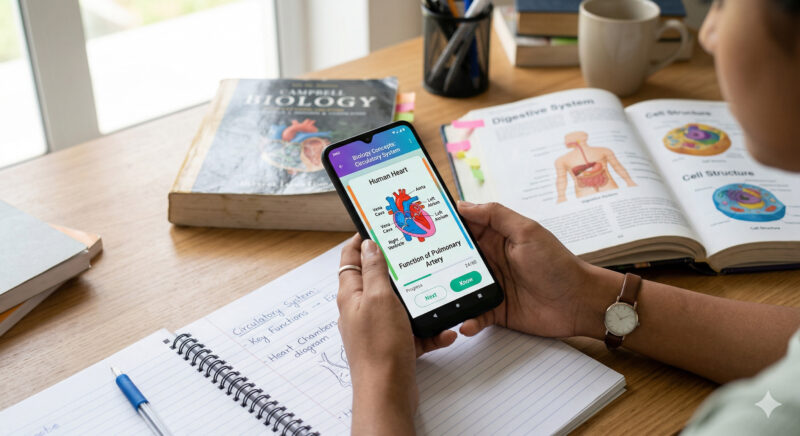
Instead of clogging your phone with 10 different coaching apps, group your digital tools into three distinct roles:
1.Primary Concept Engine:1 App Only.
Choose one core platform for covering your main syllabus lectures (e.g., Physics Wallah, Unacademy, or Khan Academy). Never watch lectures on multiple platforms for the same topic—it wastes time and creates confusion.
2.Mock Test & Analytics Suite:1-2 Apps Max.
Select one high-volume mock app like Testbook for general PYQs, plus an exam-specific app like Oliveboard for advanced sectional practice.
3.Daily Revision & Focus Stack:1-2 Utility Apps.
Install Anki for digital flashcard revision and a focus-tracking app like Forest or Focus To-Do to protect your attention span during self-study hours.
Frequently Asked Questions
1. How many apps should I keep on my phone for exam preparation?
Keep no more than 2 to 3 apps. Stacking multiple platforms leads to content overload, distraction, and fragmented study schedules. A streamlined setup includes:
- One Primary Concept Engine: For video lectures and core syllabus coverage (e.g., Physics Wallah, Unacademy, or Khan Academy).
- One Mock Test & Analytics Suite: For daily practice and test series (e.g., Testbook or Oliveboard).
- One Revision/Focus Tool: For long-term memory and discipline (e.g., Anki or Forest).
2. Which app is best for government and bank exam mock tests?
- For SSC, Railways & State Exams: Testbook provides the highest volume of Previous Year Questions (PYQs) and realistic All-India live percentile rankings.
- For High-Level Banking (SBI PO, IBPS PO, RBI Grade B): Oliveboard is the benchmark, offering higher-difficulty mock questions and detailed time-per-question analytics.
3. Can I clear competitive exams using free resources on YouTube and apps?
Yes. Channels like Physics Wallah, Unacademy Free Live Classes, and Adda247 cover almost the entire syllabus for major exams (JEE, NEET, SSC, Banking) for free. Paid subscriptions are primarily helpful for structured schedules, ad-free viewing, dedicated doubt resolution, and full-length test series.
4. How does Anki help in revising for exams like UPSC, NEET, or GATE?
Anki uses a Spaced Repetition System (SRS). When you create digital flashcards for formulas, historical dates, or biology diagrams, the algorithm schedules reviews right before your brain is likely to forget them. This shifts information from short-term memory to permanent long-term recall with minimal daily effort.
5. How should I track my performance across mock test apps?
Focus on Percentile and Accuracy Percentage rather than raw marks, as exam difficulty varies across shifts:
Target a Percentile consistently above 90% among test takers on platforms like Testbook or Oliveboard.
Aim for an Accuracy Rate above 85%–90%.

How to Get a Personal Loan in India
few years ago, I found myself in a position where I needed a significant amount…

Profitable Business Ideas for Students to Earn Money in 2026
I still remember sitting on my twin-sized college bed during my second semester, opening my…

How to Invest in Fixed Deposits in 2026
When I first started earning and saving money, the investment world felt completely overwhelming to…

The Best Stock Market Investment Tips for Beginners in 2026
When I first stepped into the stock market back in 2021, I was convinced I’d…
The Best Apps for Exam Preparation in India
When I first started preparing for competitive exams in India, my study table was a…

How to Start an E-commerce Business in India in 2026
When I took the plunge into online selling in India back in early 2024, my…