
When I first started earning and saving money, the investment world felt completely overwhelming to me. Everywhere I looked online, people were talking about stocks, crypto, real estate, and high-risk trading apps. While those options work for some, I quickly realized that I hated the feeling of going to bed worrying whether my hard-earned money would shrink overnight. I wanted a simple, safe, and predictable way to watch my savings grow without taking big risks.That is when I took a step back and returned to a traditional, time-tested tool: the humble Fixed Deposits (FD).
For a long time, I thought FDs were boring and outdated. But after testing different banks, tweaking my strategies, and making a few mistakes along the way, I realized that Fixed Deposits are one of the most reliable wealth-building tools if you know how to use them smartly.
Whether you are saving for a rainy day, planning a big future purchase, or simply wanting a portion of your money completely safe from market crashes, this is my step-by-step personal guide on how I invest in Fixed Deposits today.
Why I Still Rely on Fixed Deposits for My Money

A few years ago, I put a chunk of my emergency savings into a risky market fund because a friend convinced me I was “missing out” on high returns. Six months later, the market took a sudden dip, and I panicked seeing my balance drop. That stressful experience taught me a valuable lesson: peace of mind has real value.
I moved my core savings back into Fixed Deposits, and I haven’t looked back since. Here is why Fixed Deposits remain a permanent part of my financial plan:
- Guaranteed Returns: When I book an Fixed Deposits, I know the exact interest rate I am getting and the exact amount I will receive at maturity. No surprises, no daily market tracking.
- Capital Protection: Unlike stocks or mutual funds, the principal amount I put into an Fixed Deposits does not drop in value. My money stays completely secure.
- Predictable Planning: Fixed Deposits make budgeting effortless. If I know I need money for a specific goal in two years, I can align my deposit duration to match that exact timeline.
- Easy Liquidity Options: While Fixed Deposits are meant to lock in your money for a fixed term, most banks allow you to break them in case of a genuine emergency, or even take a small loan against them without closing the deposit.
Fixed deposits might not make you a millionaire overnight, but they provide the solid financial foundation that lets me sleep peacefully every night.
Step 1: Defining My Goal Before Opening an FD

When I first started booking Fixed Deposits, I used to just throw any extra cash I had into random 1-year deposits without a clear plan. That was a mistake. I ended up needing cash six months later and had to break my deposit early, paying a small penalty fee.
Now, before I lock away a single rupee or dollar, I sit down and assign a specific purpose to that money. I usually group my savings into three distinct buckets:
- The Emergency Fund: This is money I might need on short notice for medical bills, sudden home repairs, or unexpected job changes. For this bucket, I keep the deposit terms short (usually 3 to 6 months) or use auto-sweep facility accounts so I can access cash quickly.
- Short-Term Goals: This includes expenses I know are coming up in the next 1 to 3 years—like buying a new laptop, taking a family vacation, or paying an annual insurance premium.
- Long-Term Wealth Stacking: This is money I don’t need for 5 years or more. Here, I look for longer tenure FDs that offer higher interest rates or tax-saving benefits.
Having a clear purpose for every single Fixed Deposits stops me from breaking them prematurely and keeps my financial goals on track.
Step 2: How I Compare Banks and Find the Best Rates
One big mistake I made early on was blindly opening all my Fixed Deposits at the primary bank where I keep my salary account. I assumed all banks offered roughly the same rates.
When I finally decided to check other options, I was shocked to find that smaller finance banks and corporate institutions were offering significantly higher interest rates for the exact same tenure. Moving my funds over meant earning noticeably more interest each year without taking on extra work.
Here is my personal checklist for comparing banks before booking an Fixed Deposits:
- Check Small Finance Banks: Reputable smaller banks often offer 0.5% to 1.5% higher interest rates than major traditional banks to attract new depositors.
- Look at Special Tenures: Banks often run special promotional schemes for specific durations—like 400 days or 777 days—that carry higher interest rates than standard 1-year or 2-year options.
- Check Senior Citizen Benefits: If you are booking an Fixed Deposits in the name of your parents or grandparents, take advantage of senior citizen rates. They typically receive an additional 0.50% interest bonus.
- Verify Deposit Insurance: Before picking any bank, I always make sure it is covered by official government deposit insurance schemes (like DICGC in India or FDIC in the US). This guarantees my principal up to the legal safety limit even if the bank faces financial trouble.
Comparing options across three or four reliable banks takes me less than twenty minutes online, but it adds up to a noticeable boost in my annual returns.
Step 3: My Favorite Strategy—FD Laddering
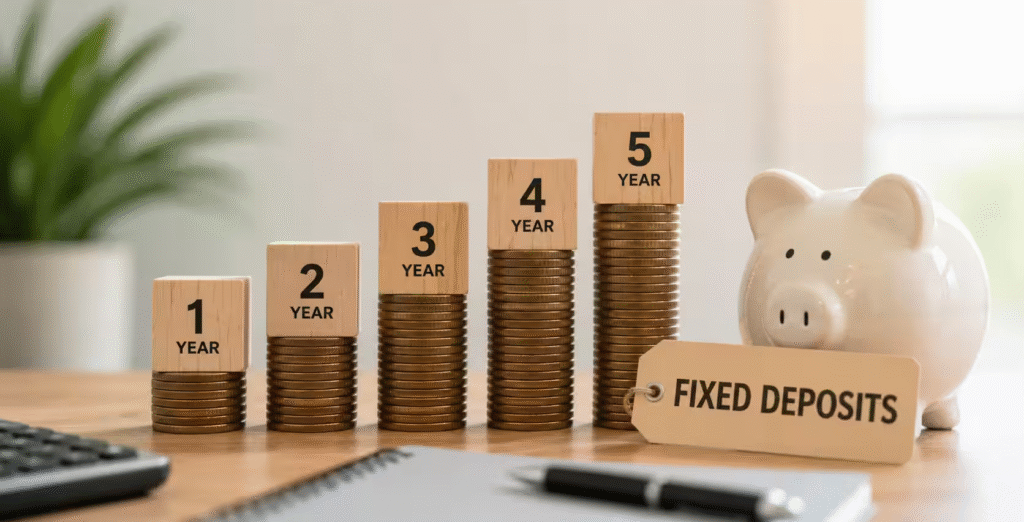
Locking all your money into a single 5-year Fixed Deposits can feel risky. If interest rates rise next year, you are stuck with your lower rate. Even worse, if you need cash urgently, you have to break the entire deposit and lose your interest benefits.
To solve this problem, I started using a smart technique called FD Laddering. This is easily the best strategy I have implemented in my personal finances.
Instead of putting a lump sum of $10,000 (or ₹1,00,000) into one single 3-year FD, I divide that money into three equal parts and book three separate deposits with different maturity dates:
- Deposit A: 1-Year Tenure
- Deposit B: 2-Year Tenure
- Deposit C: 3-Year Tenure
Here is why this strategy works so brilliantly for me:
When Deposit A matures at the end of Year 1, I reinvest that money into a new 3-year FD. When Deposit B matures at the end of Year 2, I reinvest it into another 3-year FD.
Eventually, I reach a stage where I have an FD maturing every single year. This gives me regular access to cash without breaking any deposits, and it allows me to capture higher interest rates whenever rates rise in the market.
Step 4: Cumulative vs. Non-Cumulative—How I Choose
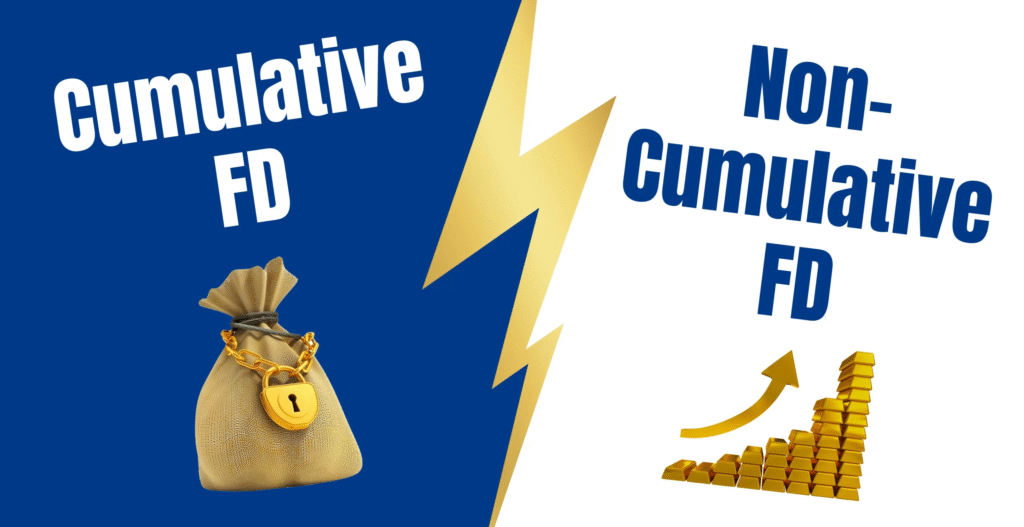
When you open a Fixed Deposit, the bank will ask you to pick between two types: Cumulative and Non-Cumulative.
I didn’t pay attention to this choice on my first few FDs, but understanding the difference completely changed how I manage my monthly cash flow.
Here is how I choose between them based on my personal needs:
- Cumulative FDs (Best for Reinvesting & Growth): In a cumulative FD, the interest earned each quarter or year is added back to your principal amount. This means you earn interest on your interest (compounding). You get the entire sum—your principal plus all accumulated interest—at the end of the maturity period. I pick this option when I am saving for long-term goals and don’t need regular income.
- Non-Cumulative FDs (Best for Regular Income): In a non-cumulative FD, the bank pays out your earned interest at regular intervals—monthly, quarterly, or annually—directly into your savings account. I use this option when I want a steady stream of extra pocket money or to help cover recurring household bills.
If you don’t need immediate income, I highly recommend choosing the cumulative option so your money grows exponentially through compounding.
Step 5: Understanding Taxes on Fixed Deposit Interest

One harsh reality I discovered after my first couple of years investing in FDs is that the interest you earn is not completely tax-free.
In most financial systems, the interest income earned from FDs is added to your total annual income and taxed according to your personal income tax bracket. Furthermore, if your total interest earnings from a bank cross a specific limit in a single year, the bank automatically deducts Tax Deducted at Source (TDS) before paying out your maturity amount.
Here are a few personal steps I take to manage my FD tax burden:
- Submit Tax Exemption Forms: If your total annual income falls below the taxable threshold, make sure to submit the required exemption forms (like Form 15G or Form 15H in India) to your bank at the start of every financial year so they don’t unnecessarily deduct TDS.
- Spread FDs Across Multiple Banks: Instead of keeping all your deposits at one bank, spreading them across two or three different banking institutions can help keep your interest earnings per bank below the automatic TDS threshold.
- Consider Tax-Saving FDs: If you want to reduce your taxable income, most banks offer 5-year Tax-Saving Fixed Deposits. These lock your money in for a strict 5-year period, but the invested principal qualifies for tax deductions under standard government tax rules.
Being aware of taxes beforehand stops you from getting a surprise tax bill at the end of the year.
Step 6: How I Book an Fixed Deposits Step-by-Step
Gone are the days when you had to stand in long bank queues, fill out paper forms, and submit physical photos just to open a Fixed Deposit. Today, I do my entire FD management right from my mobile phone while sitting on my couch.
Here is the simple digital process I follow:
- Log in to Mobile Banking: Open your bank’s official app or internet banking portal.
- Navigate to Deposits: Look for the “Fixed Deposit”, “Term Deposit”, or “e-FD” section.
- Select Amount & Tenure: Type in the amount you want to deposit and choose the duration (months or years) that fits your plan.
- Choose Interest Payout: Select whether you want a Cumulative deposit (payout at maturity) or Non-Cumulative (monthly/quarterly interest payouts).
- Add a Nominee: Never skip this step! Always add a family member or trusted person as a legal nominee so your funds are safely accessible to your loved ones in case of an emergency.
- Review and Confirm: Double-check the interest rate, maturity date, and final payout amount, then enter your PIN or OTP to instantly lock in your deposit.
Once confirmed, you can download a digital receipt or FD certificate immediately for your records.
Common Fixed Deposits Mistakes I Made (So You Can Avoid Them)

Looking back over my financial journey, I made a few silly mistakes with Fixed Deposits that cost me time and money. Here are the top errors I actively avoid today:
- Forgetting About Automatic Renewal: Most banks have a default setting where your FD automatically renews for the same tenure when it matures. If you forget about your maturity date, your money might get locked away again when you actually needed it. I always set a calendar reminder on my phone a week before an FD matures.
- Ignoring the Early Withdrawal Penalty: If you break an FD before its maturity date, banks usually charge a premature withdrawal penalty (usually around 0.5% to 1.0% off your earned interest rate). Keeping a dedicated emergency fund stops you from having to break your main FDs early.
- Leaving All Money in Low-Yield Savings Accounts: For a long time, I left far too much cash sitting in my basic savings account earning a tiny 2% to 3% interest. Moving that extra cash into short-term FDs immediately bumped my returns to 6% or 7% with zero extra risk.
FAQ’s

How to Get a Personal Loan in India
few years ago, I found myself in a position where I needed a significant amount…

Profitable Business Ideas for Students to Earn Money in 2026
I still remember sitting on my twin-sized college bed during my second semester, opening my…
How to Invest in Fixed Deposits in 2026
When I first started earning and saving money, the investment world felt completely overwhelming to…

The Best Stock Market Investment Tips for Beginners in 2026
When I first stepped into the stock market back in 2021, I was convinced I’d…

The Best Apps for Exam Preparation in India
When I first started preparing for competitive exams in India, my study table was a…

How to Start an E-commerce Business in India in 2026
When I took the plunge into online selling in India back in early 2024, my…